EN
EN

When evaluating energy efficiency for public transit infrastructure, one thing I've noticed consistently is that the electricity cost for information displays gets underestimated. A city-operated network of bus stop screens running 24 hours a day doesn't look expensive on paper until you multiply it by hundreds of locations and several years of operation. That's the moment when a solar-powered led display stops being a curiosity and starts looking like a genuine operational solution.
Modern solar led display systems deployed at smart bus stops can run without drawing power from the municipal grid while still delivering the brightness, refresh rate, and content reliability that passengers and transit operators need. That's a strong claim — and if your installation environment gets consistent daily sunlight, it largely holds up. The details matter, though.
Why Bus Stops Are Moving to Solar-Powered LED Displays
The shift toward solar-integrated transit information screens is driven by a few practical pressures. Smart city infrastructure programs increasingly require that new bus shelters be self-sufficient or grid-independent where cabling is cost-prohibitive. The total cost of wiring up remote transit corridors — trenching, cabling, grid connection permits — can easily outpace the cost of the led display hardware itself.
Solar panel efficiency has improved enough that a compact monocrystalline panel — around 100W, roughly the size of a standard door — can reliably charge a battery system that sustains a moderate-size outdoor led display through the night and cloudy stretches. This makes solar LED bus stop displays viable not just in sunbelt regions, but increasingly across mid-latitude climates as well.
Removing the grid dependency simplifies the deployment of real-time passenger information systems, route updates, and advertising content across distributed shelter networks. Each unit becomes independently powered and remotely managed — an operational advantage that matters when transit authorities managing large footprints.
How Solar Energy Powers a Full-Performance LED Display
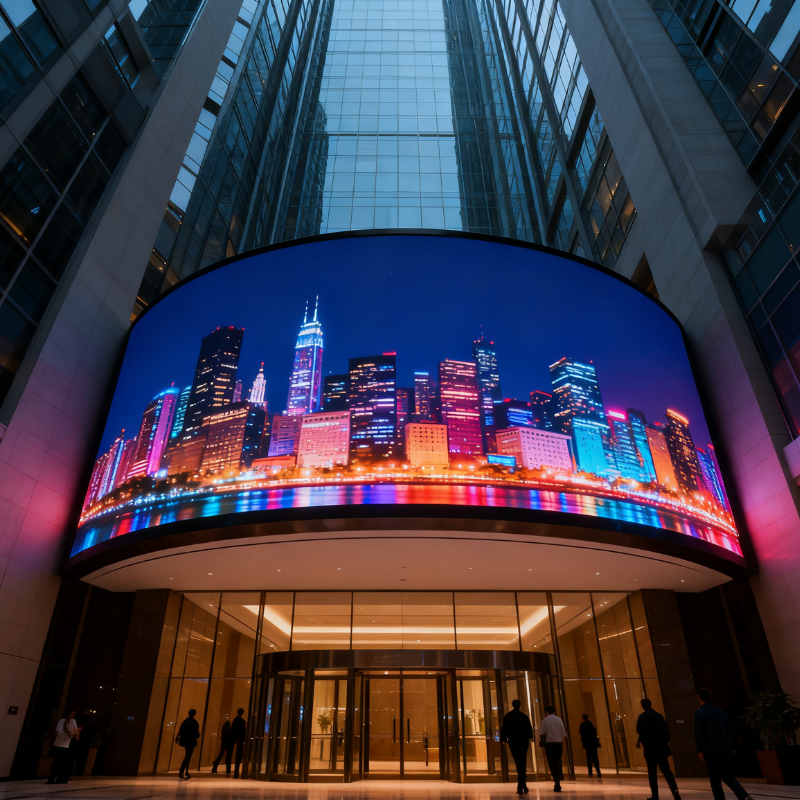
The core of a solar led display system for bus stops is a closed energy loop: photovoltaic panels capture solar radiation during daylight hours, a charge controller manages the flow into a deep-cycle battery bank, and the battery powers the LED display module during operation — day or night. In a well-sized system, the result is a led display that runs continuously without drawing a single watt from the utility grid.
"Full performance" means the led display delivers brightness sufficient for daylight readability — typically in the 5,000–8,000 nit range for direct sunlight environments — content update capability via wireless connection, and reliable continuous operation. Solar led display systems are optimized for energy efficiency, using low-power LED modules and intelligent brightness dimming during overnight periods.
One design consideration that often surprises project teams: the panel orientation and shading from shelter rooflines or adjacent structures can significantly affect charging output. Proper site assessment — not just panel wattage selection — determines whether the system sustains full led display operation year-round.
Key Technical Specifications for Solar Bus Stop LED Displays
For procurement teams and transit integrators evaluating solar led display options, several technical parameters deserve close attention:
- Protection rating: Outdoor bus stop displays require at minimum IP65 protection — fully dust-tight and rated to withstand low-pressure water jets from any direction. Coastal or tropical environments may warrant IP66 or higher.
- Solar panel capacity: For a led display in the 20–40 inch range running transit content, a monocrystalline panel in the 80–150W range is a common starting point. Sizing should account for local peak sun hours, battery reserve days, and display power draw under maximum brightness.
- Battery chemistry: Lithium iron phosphate (LiFePO4) batteries are preferred for solar transit displays due to cycle life, thermal stability, and tolerance for partial state of charge.
- Pixel pitch: For passenger information at bus stops, P4–P6mm is appropriate for viewing distances of 3–6 meters. Higher resolution increases power draw without visible benefit at typical transit distances.
- Content management: Remote wireless updating via 4G/LTE is standard. The led display controller and software need compatibility with the transit operator's systems or operate as a standalone cloud-connected unit.
Addressing the Real Reliability Concern: Low-Sun Days
The most legitimate concern about solar-powered led display systems is continuity during extended low-sunlight periods — overcast winter days, rainy seasons, or high-latitude deployments with short daylight windows. This is a real engineering constraint.
Three approaches manage this: oversizing the battery bank to provide 3–5 days of autonomy without recharging, integrating an optional grid-backup port for critical locations, or implementing automatic brightness reduction during low-battery states that keeps essential passenger information visible while reducing power draw.
Solar led display deployments in tropical and subtropical markets — Southeast Asia, the Middle East, sub-Saharan Africa, Latin America — tend to be the most reliable, with high average daily solar irradiance. In higher-latitude markets, the system needs to be designed for the worst-case winter week, not the summer average. If specifying a solar led display for a northern European or high-altitude deployment, the panel and battery sizing must reflect that seasonal reality.
Smart Bus Stop Integration: Beyond the Display
Modern smart bus stop deployments treat the led display as one component within a broader connected shelter system. A fully integrated solar smart bus stop might combine the passenger information display with ambient LED lighting, a USB charging point, an air quality sensor, and a cellular connectivity hub — all powered by the same solar and battery infrastructure.
This integration approach distributes the solar investment across multiple functions, improving the cost-per-benefit calculation. The led display is typically the highest-visibility component but not necessarily the largest power consumer in the shelter system.
From a maintenance perspective, solar led display systems at bus stops have a meaningful advantage: no electrical trenches, no connection points vulnerable to moisture ingress, and no dependency on municipal grid reliability. Maintenance involves periodic cleaning of the solar panel — dust accumulation can reduce output by 10–20% in arid environments — and eventual battery replacement, typically after 8–12 years for LiFePO4 cells.
Procurement Considerations for Transit Authorities and Integrators
When specifying solar led display solutions for a bus stop network, key questions to resolve before issuing a procurement specification:
- Minimum acceptable display operation time per day? A transit authority running 18-hour service days has different requirements than one with a 12-hour schedule.
- Worst-case solar conditions at the deployment location? Seasonal minimum insolation data should drive sizing, not annual averages.
- Required content update frequency? Real-time bus arrival data requires persistent wireless connectivity; static route information needs lower energy investment.
- How is the system monitored? Remote monitoring of battery state, led display status, and panel performance data enables proactive maintenance across distributed shelter networks.
JunChen Display brings direct manufacturing capability and multi-market export experience to solar led display projects across Southeast Asia, the Middle East, Africa, and Latin America. With a product line covering both solar-powered and standard outdoor LED configurations, the company supports projects from pilot installations to large-scale network rollouts.
The technology premise — zero grid power, full passenger information performance — is achievable today with properly engineered solar led display systems. The key is site-specific sizing, display components optimized for efficiency, and operational design designed around seasonal variation, not ideal conditions.
 Hot News